
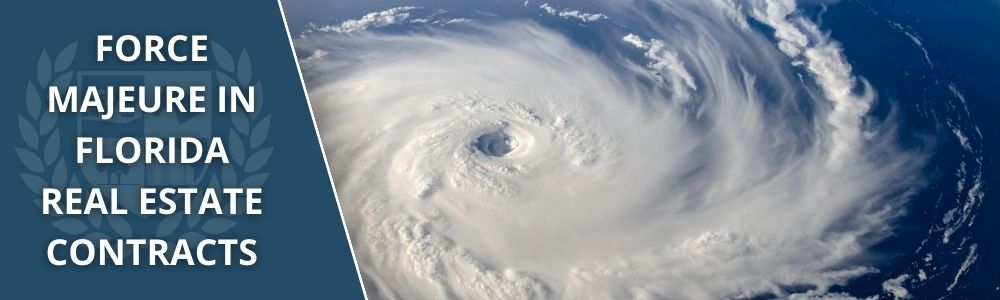
Force majeure in real estate contracts refers to unforeseeable circumstances that prevent a contract from being fulfilled. It’s a French term that translates to “greater force” or “superior force.” The force majeure clause is a way of protecting someone from liability if they’re unable to meet the terms of a contract due to an unexpected event that’s outside of their control. Force majeure events may include severe weather, earthquakes, civil unrest, labor strikes, war, and government actions (such as an evacuation order or a pandemic quarantine and government-ordered shutdown).
The most obvious example of a force majeure in Florida is a hurricane and flooding. Force majeure clauses have become increasingly important in real estate leases and sale contracts because of issues like the pandemic and the increasing severity of storms due to climate change. In this blog, we’ll explain what you need to know about force majeure clauses in your personal and business life.
What Is the Force Majeure Clause in Real Estate?
Within real estate contracts, a force majeure clause would typically be used to delay a closing. While rarely discussed outside of legal circles, real estate, and contracts, force majeure became more well-known during the COVID-19 pandemic when government shutdowns caused delays to the closing process. Of course, a force majeure clause can apply to hurricanes, tornadoes, fires, and other events.
Think of the many steps involved when buying a property. A closing delay for any reason, even if it’s outside of your control, could affect someone’s ability to finance a purchase if the lock on their mortgage rate expires.
Even the threat of a major disaster could impede your ability to buy property insurance and flood insurance, since insurance companies could put a hold on new policies if a tropical storm or hurricane is approaching. Mortgage lenders require property insurance and flood insurance is required for any federally-backed mortgage, so a hold on new policies could affect your ability to close on a property.
If a storm or some other event does happen, it could also delay the appraisal process, destroy documents, and impede the closing and move-in dates.
Types of Force Majeure Events in Real Estate
A force majeure event in real estate typically requires three things to be invoked:
-
- An event was unavoidable.
- It wasn’t expected when the contract or lease was signed.
- It wasn’t caused by either party.
Examples of force majeure events in real estate could include:
-
- Property damage from fire or severe weather.
- Government shutdowns (such as the COVID-19 pandemic), which delay a property closure or permitting process.
- A work stoppage because of a labor strike or a shortage of materials from a supply chain disruption.
For a force majeure event to apply to a lease or a sale contract, it must be listed within the document. Depending on the nature of the event this clause could be invoked to extend a contract until conditions have changed, to allow a transfer at a later date. It might also be invoked to terminate a contract at no additional cost or liability to either party. For example, this might happen if a structure is destroyed or deemed uninhabitable because of damage from a natural disaster. If that cause was listed as a force majeure in the sale contract, it could be used to nullify the agreement.
The Commercial Real Estate Force Majeure Clause
While force majeure clauses are often included in residential sale contracts, they’re more commonly invoked within commercial real estate. This includes contracts for sale, construction agreements, service contracts, and rental agreements. A force majeure clause could be invoked if a covered event prevents a landlord from providing a particular service on time, such as routine maintenance or a buildout for a new tenant. This clause would typically be used to delay either party’s obligations, without penalty, for the duration of a qualifying event.
How a force majeure is implemented depends on how it’s written in a lease or contract. During the COVID-19 pandemic, many landlords discovered that health emergencies were not included in their force majeure clauses, but this language is now usually included in lease agreements.
An effective force majeure clause goes beyond a list of covered events. It must clearly outline how each party is to handle a disruption. This includes how each party must notify the other and the deadlines for doing so, such as a notification in writing within 10 business days of a covered event. It would stipulate the timeline for delaying a contract, as well as the timing and methods of terminating an agreement.
For example, the clause might stipulate that a contract can be terminated within 60 days of a force majeure disruption, within 15 days of delivering a written notification to the other party. A force majeure clause might also include a mitigation requirement that gives either party the time to comply with a contract or lease agreement once a covered event has passed.
How To Handle Force Majeure in Property Contracts
In commercial real estate, force majeure clauses are usually tailored to fit the circumstances of each transaction. These days, many commercial leases have a force majeure clause that includes government-mandated shutdowns and other restrictions, such as remote work. Retail and restaurant properties might also include language about supply chain disruptions and limits on their maximum occupancy. For new developments or buildouts for a new tenant, a clause might cover delays from contractors and supply issues, as well as issues with government permits.
To make sure you’re fully protected by a force majeure clause, it would have to include specific language that clearly spells out what’s covered. A reference to “unforeseen events” would likely be too vague and unenforceable in court. It would have to list each covered event, how a covered event is documented by either party, how long the force majeure exemption lasts, and whether a contract would be delayed or terminated based on the type of event and its duration. For example, a force majeure clause might allow the termination of a contract or lease if the disruption lasts for a given number of days.
For rental properties, a force majeure clause usually wouldn’t offer a pause in rental payments unless specifically stated within the lease. If a commercial mortgage was granted based on a property’s rental income, a landlord would probably need their lender’s approval to use a force majeure to adjust the terms of a lease. Any changes a property’s leases without the lender’s approval could put the borrower in default.
Additionally, many retail shopping centers have “co-tenancy” requirements that allow tenants to reduce or terminate a lease if an anchor tenant vacates the property or if a certain percentage of a property’s retail space is vacant. If an anchor tenant left or went out of business because of a force majeure event, the impact of that loss could be compounded by the remaining tenants adjusting or terminating their leases.
What Happens during a Force Majeure Event in Florida
A force majeure event must be something unforeseeable that happens outside the powers of both parties and impedes the timely enforcement of a contract. An event must also be stipulated within the contract to be covered by the force majeure clause.
If a force majeure clause requires either party to notify the other within a specific time period, that deadline must be met. For example, if a hurricane is listed in the force majeure clause of a contract, a late notification could still invalidate a force majeure claim even if the storm itself caused the communication delay.
Notification of a force majeure would likely involve an attorney who is experienced in such matters. It ought to list the reason for the force majeure, the event dates, and its impact on the lease or sale contract. Follow-up communications may be required, if the disruption continues to impede the execution of the contract.
When a force majeure event happens, the parties involved must take reasonable steps to reduce its impact on the affected property. This could include finding alternative supply chains, hiring a different contractor, or delaying the completion of a sale under the terms of the force majeure clause.
Documentation will be important in case of a force majeure. This includes:
-
-
- Official government notices such as weather advisories and evacuation orders.
- Documentation of how the property or its operations were affected. This may include pictures, videos, and communications between both parties.
- Proof of mitigation efforts, such as repair work after a property-damaging event.
-
We Can Help You Find the Right Residence or Commercial Property in Florida
Contact Showcase Properties for guidance on buying or selling a home or investment property with our expert realtor services. We can help you find the right property in Central Florida and walk you through the entire process. Please check out our featured listings online, and see our blog posts on buying a property in Florida.